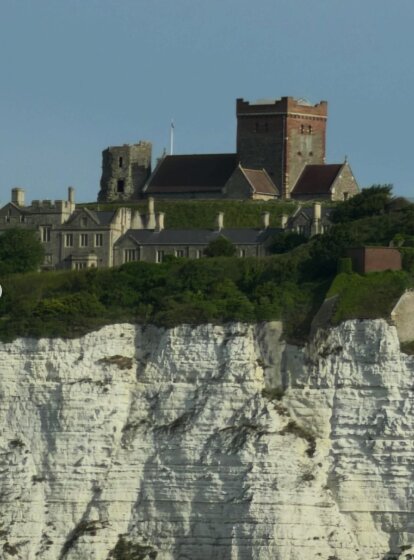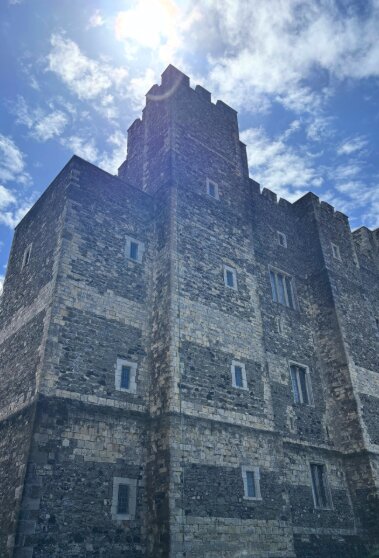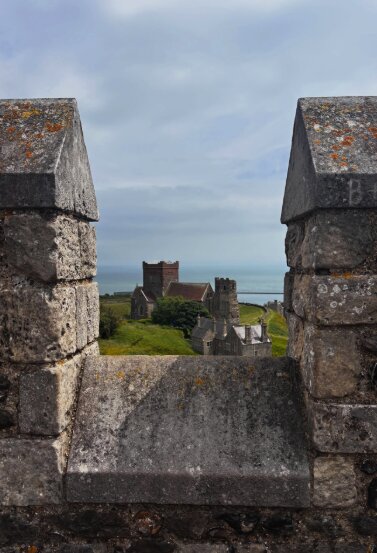
Most visitors to Dover spend their time at the castle and the White Cliffs — which is exactly right. But the area around Dover contains several places that most tourists never find, each with a genuine story to tell. These are the ones worth seeking out if you have extra time or are returning for a second visit.
1. The Dover Bronze Age Boat — Inside a Shopping Centre
The Dover Bronze Age Boat is one of the most significant archaeological discoveries in Britain — a 3,500-year-old seafaring vessel found during construction work in 1992, now housed in a purpose-built gallery inside Dover's main shopping centre on Market Square. This is, without question, the oldest seagoing vessel known to have survived anywhere in the world.
The boat dates from around 1550 BC, is 9.5 metres long, and was built to carry cargo and possibly passengers across the English Channel. Think about that: people were crossing these 21 miles of water in oak plank vessels 3,500 years ago. The gallery around the boat at the Dover Museum displays the tools, cargo, and context of Bronze Age cross-Channel trade.
Entry to Dover Museum is free. It takes about 45 minutes to see properly. Almost no visitor to Dover Castle knows it exists.
The Bronze Age Boat was found just 50 metres from where archaeologists believe a major Bronze Age harbour once stood. Dover was an international trading port more than 1,000 years before Julius Caesar arrived in Britain.
2. St Margaret's Bay — The Ian Fleming & Lord Byron Connection
St Margaret's Bay is a small cove 4 miles east of Dover, accessible by car or a 1.5-mile coastal path walk from the Langdon Cliffs car park. It is the closest point in England to France (about 21 miles), and has attracted an extraordinary concentration of notable residents over the years.
Ian Fleming, creator of James Bond, lived in a house called White Cliffs at St Margaret's Bay. Fleming wrote several Bond novels here and the bay's combination of dramatic chalk cliffs, sea views, and isolation clearly influenced the character of 007's world. The connection is subtle rather than signposted — there is no visitor centre or gift shop — but for Bond aficionados, standing at the cove where Fleming looked out at France is genuinely moving.
Lord Byron also stayed at St Margaret's Bay, reportedly describing the view from the cliffs as the most beautiful thing he had ever seen. Noel Coward, the playwright and composer, lived nearby. This small stretch of coastline has an improbable literary concentration.
The bay itself has a shingle beach, a small pub, and the Matthew Webb statue (Webb was the first person to swim the English Channel, in 1875). On a clear day, the view to France from the cliff above is outstanding.
The coastal path from the Langdon Cliffs National Trust car park to St Margaret's Bay is one of the best short cliff walks in England — 1.5 miles each way with consistently dramatic views. Wear proper footwear and allow 45 minutes each way. The pub at the bay is a good stop before the walk back.
3. The Roman Painted House — Europe's Finest In-Situ Roman Paintings
Beneath the streets of Dover town centre, in a basement near New Street, sits The Roman Painted House — a 2nd-century AD Roman building with the most complete series of in-situ Roman wall paintings north of the Alps. The paintings depict elaborate architectural scenes: painted columns, architraves, niches, and garden scenes in vivid reds, greens, and ochres that have survived 1,800 years underground.
The site was discovered in 1970 during construction work. It has been preserved beneath a protective building that you enter like a museum gallery — but what you're looking at is the actual room, with the actual floor, and the actual walls, exactly where they were when Roman soldiers and traders occupied them. Entry is around £4. It's a 15-minute walk from Dover Castle, almost entirely unknown to international tourists, and genuinely remarkable.
4. The Western Heights — Napoleon's Ghost
Across the valley from Dover Castle, on the opposite cliffs, sit the Western Heights — a vast complex of Napoleonic-era fortifications built to defend Dover from inland attack during the threat of French invasion between 1804 and 1815. The Drop Redoubt and the Grand Shaft (a triple-helix staircase cut into the chalk) are the most accessible sections.
The Grand Shaft is extraordinary: a 140-foot vertical shaft with three intertwined staircases allowing soldiers, officers, and their wives to descend simultaneously to the town below without meeting each other. It was a social engineering solution to the class system: three helical staircases, each accessed by a different entrance, ensuring that officers and enlisted men never crossed paths on the stairs. English Heritage runs occasional open days for the Western Heights; check their website for dates.
The Western Heights fortifications were built with one eye on a French invasion that never came. Napoleon assembled an army of 180,000 soldiers at Boulogne — visible from these cliffs on clear days — but his defeat at Trafalgar in 1805 made a Channel crossing impossible. The fortifications were never tested.
5. Deal Castle — Henry VIII's Finest Artillery Fort
Seven miles along the coast from Dover, Deal Castle is the most perfectly preserved of Henry VIII's coastal artillery blockhouses and one of the finest examples of Tudor military architecture in England. Its distinctive rose-shaped design — a central round tower surrounded by six semi-circular bastions, themselves surrounded by a further ring — was calculated to provide overlapping fields of fire covering all approaches from the sea.
Deal Castle is managed by English Heritage, meaning it's free for members and costs a few pounds for non-members. It takes about an hour to explore. Combined with a visit to Dover Castle on the same day, it gives you an extraordinary picture of England's defensive strategy across two different centuries — the medieval keep on the hill and the Tudor artillery fortress on the beach, 500 years apart in design philosophy.
6. The Bleriot Memorial — Where Aviation History Was Made
On the clifftop just west of the Langdon Cliffs car park, a small granite marker and a replica monoplane propeller mark the spot where Louis Bleriot landed on 25 July 1909 after completing the first powered crossing of the English Channel — a journey of 37 minutes from Baraques, near Calais, in a fragile wooden monoplane with a 25-horsepower engine.
The landing was one of the most significant events in aviation history, and certainly one of the most dramatic: Bleriot had no compass, navigated by following a French destroyer across the Channel, lost sight of it in cloud, found the English coast by luck, and landed in a field above the White Cliffs to find a French journalist — who had arrived by ferry — waiting to greet him. The memorial is 5 minutes' walk from the Langdon Cliffs car park and takes 10 minutes to visit.
For opening hours and tickets for Dover Castle itself, see our Visitor Information page. To book a Dover Castle guided tour from London that covers the castle and the White Cliffs in one day, see the full range of tours on the homepage.